
Gove County Criminal Court Records
A Gove County criminal court record is the case-level file kept by the court after the State of Kansas files charges against a defendant. It is broader than a charge listing. It may contain the complaint or information, warrant or summons entries, bond conditions, first appearance, counsel appointment, preliminary hearing, arraignment, motions, trial entries, plea, dismissal, conviction, sentencing, restitution, fines, fees, probation, revocation, and post-judgment orders. The full case file and final outcome belong here, while a narrower look at charges after arrest belongs on the court charge records path.
Gove County criminal cases are handled in Kansas District Court when they are filed as district court matters. Gove County is part of the 23rd Judicial District with Ellis, Rooks, and Trego counties. Kansas district courts are general-jurisdiction trial courts and hear felony cases, misdemeanors filed in district court, state traffic crimes, fish and game matters, juvenile matters, care and treatment, protection orders, and related proceedings. Quinter Municipal Court can handle some municipal ordinance or municipal traffic matters, so a citation or notice should be checked for the named court.
The manifest included a failed county attorney screenshot with no image file, so no image is inserted for that entry. The Gove County Attorney facts are still used from the research: the county attorney prosecutes felony, misdemeanor, domestic battery, county traffic, juvenile offender, alcohol/drug care and treatment, and child-in-need-of-care matters.
Search Gove Criminal Court Records
The main online channel is Kansas CaseSearch, the Kansas Judicial Branch portal for public district court case information and public documents. Official descriptions state that users can search Kansas district court records by case number, party name, business name, citation, or other criteria available for the user's role. If a criminal case is sealed, confidential, not yet filed, municipal, or too new for the system, it may not appear in a public search.
- Start with Kansas CaseSearch for public district court cases tied to Gove County.
- Search by defendant name or case number. A case number from a notice, bond paper, or docket entry gives the clearest match.
- Use citation or role-based criteria only when the matter was filed as a public district court case.
- Open the case result to review docket entries, hearing settings, charges, disposition, sentence, and public document links when available.
- Request certified copies or non-online public documents from the Gove County District Court clerk.
For statewide agency context, the Kansas Bureau of Investigation maintains criminal justice information resources, but court case lookup and criminal history dissemination are not the same thing. A public Gove County criminal court record shows what happened in court. A criminal history record may be controlled by separate Kansas dissemination rules and may not match the public court docket in scope or use.
The manifest image for the Kansas Bureau of Investigation homepage gives statewide criminal justice context for Gove County criminal court records.
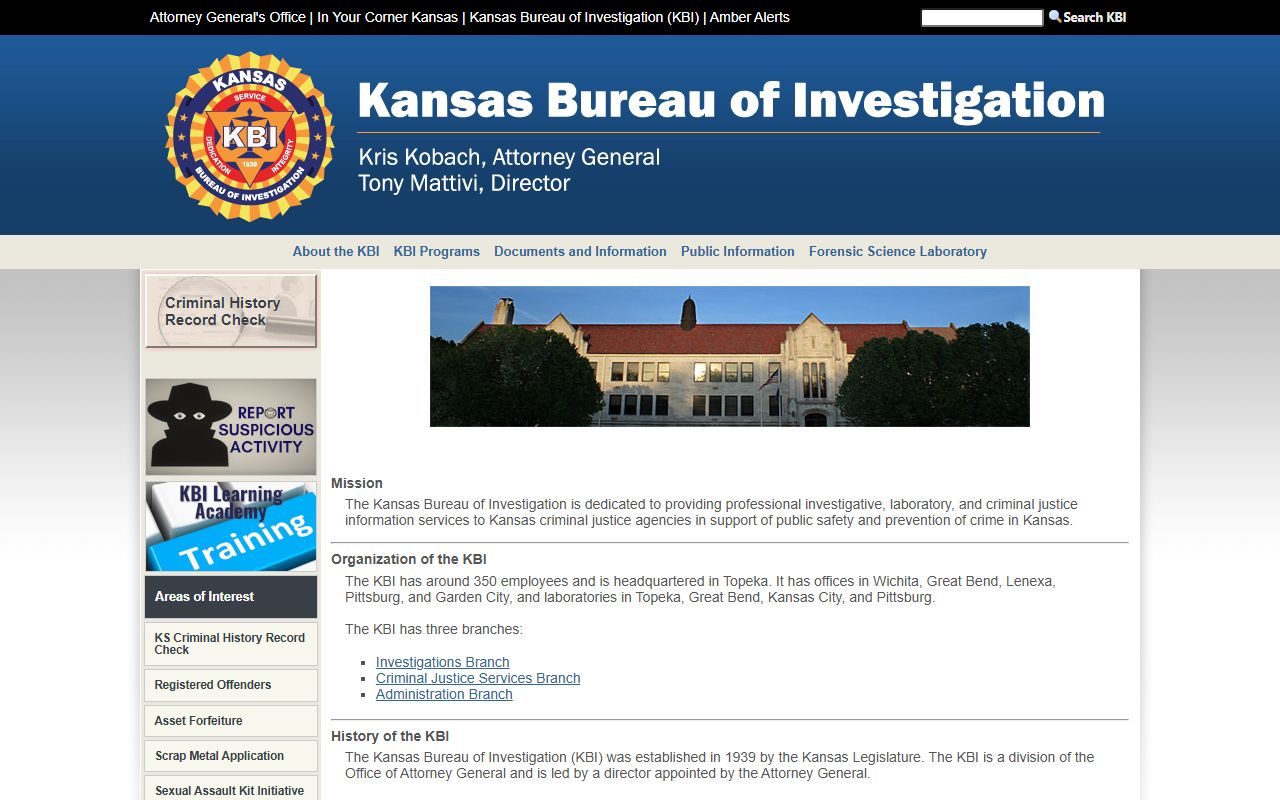
That KBI channel should not be confused with the district court case file, which is searched through Kansas courts and requested from the clerk when copies are needed.
Gove Criminal Case Flow
A criminal case develops in stages. The docket may start with a complaint, information, warrant, summons, bond, or first appearance, then move through arraignment and pretrial settings. Motions and orders can change the path. The case may end through dismissal, diversion, plea, trial verdict, sentencing, probation, revocation, or post-judgment orders. Each stage can leave a docket entry or document in the case file when the record is public.
Case flow: Charges Filed › First Appearance › Arraignment › Pretrial / Motions › Plea or Trial › Disposition › Sentencing
| Stage | What Happens |
|---|---|
| Charges Filed | The State of Kansas files the charging document, and the clerk assigns a case number after proper filing. |
| First Appearance | The defendant is advised of the case, bond or release terms may be addressed, and counsel issues may arise. |
| Arraignment | The charges are addressed formally, and a plea may be entered depending on the case type and stage. |
| Pretrial / Motions | The parties file motions, respond to discovery issues, set hearings, negotiate pleas, or prepare for trial. |
| Plea or Trial | The case may resolve through a plea, dismissal, diversion, or trial verdict. |
| Sentencing | The court imposes sentence terms after conviction, including custody, probation, costs, restitution, or other orders. |
Gove Criminal Record Fields
A Gove County criminal court record can contain both event history and document details. The research identifies charges, statute citations, count numbers, warrant or summons issue, bond amount or type, first appearance, arraignment, plea, diversion, dismissal, conviction, sentencing, probation terms, revocation, restitution, costs, and jail or prison credit as possible criminal case fields. Some fields may not appear publicly if the record is sealed, expunged, juvenile, or redacted.
| Field | What It Shows |
|---|---|
| Case Number | The district court identifier assigned after proper filing by the Clerk of the District Court. |
| Defendant | The person charged in the State of Kansas case, subject to redaction or confidentiality rules when applicable. |
| Charges | The filed counts, statute citations, severity or classification, and any amended, dismissed, or reduced charges. |
| Warrant or Summons | Whether court process was issued, returned, sealed, or tied to a later appearance or enforcement event. |
| Bond | Bond amount, type, release conditions, or bond changes when those terms are public. |
| Plea | The defendant's formal answer to a charge, including guilty, not guilty, or other plea entries. |
| Disposition | The outcome, such as dismissal, diversion, conviction, acquittal, plea resolution, or other court ruling. |
| Sentence | Custody, probation, revocation, restitution, fines, fees, costs, jail credit, and post-judgment orders. |
The KBI media release archive is a statewide law-enforcement news source, not a substitute for a filed Gove County criminal case record.
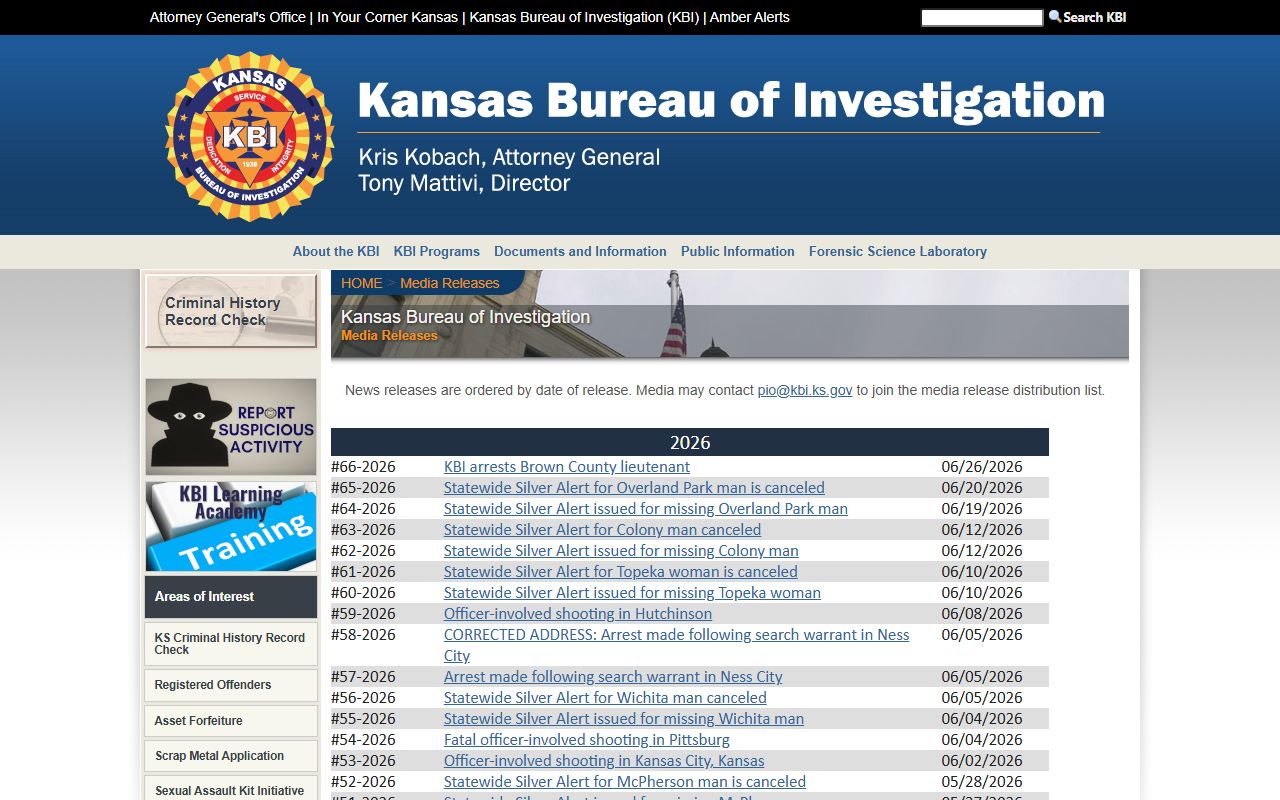
News releases and agency notices may help identify an event, but the court record is the source for charges filed, pleas, disposition, and sentencing.
Gove Charges vs Convictions
Charges and convictions are different parts of a criminal court record. A charge is an accusation filed in court. It may be amended, reduced, dismissed, diverted, or tried. A conviction is the result of a guilty plea, guilty finding, or verdict accepted by the court. A Gove County criminal court record can show charges that did not become convictions, so the disposition and sentence fields must be read with the charge entries.
| Charge | Conviction | |
|---|---|---|
| Case Stage | Filed accusation or count. | Outcome after plea, finding, or verdict. |
| Record Meaning | Shows what the State alleged in court. | Shows that guilt was accepted or found by the court. |
| Can Change | May be amended, reduced, dismissed, or dropped. | May later be affected by appeal, expungement, or post-judgment order. |
| Where to Read | Charging document and docket entries. | Disposition, judgment, sentence, and post-judgment entries. |
Note: The criminal page is for full court case files, not arrest records or jail booking data.
Gove Sentences and Dispositions
Disposition language tells how a count, claim, or case ended. A dismissal means the count or case was not carried forward as a conviction. Diversion can move the matter into a separate compliance path before final outcome. A plea entry may lead to sentencing. A trial can end with guilty or not guilty findings. Sentencing entries can show custody, probation, fines, costs, restitution, conditions, jail credit, and later revocation or modification proceedings.
Reading a Gove County criminal court record requires matching the count to its outcome. A case can have several counts, each with a different disposition. One charge may be dismissed while another leads to a plea. A sentence may include probation terms and restitution even when no jail or prison term appears in the public summary. If a public docket is unclear, the certified judgment or sentencing order from the clerk is the stronger record.
Gove Criminal Records Access
Public access to Gove County criminal court records starts with court access rules and the Kansas Open Records Act framework. K.S.A. 45-218 addresses inspection requests, agency responses, refusals, and fees for public records. K.S.A. 45-219 allows copy fees and actual costs. K.S.A. 45-221 lists records an agency is not required to disclose. Court records also have separate sealing, confidentiality, and redaction rules.
Criminal history dissemination has another limit. K.S.A. 22-4707 restricts dissemination of criminal history record information by criminal justice agencies. That does not erase public court records, but it does mean an agency background check, a court docket, and an online case result may not be the same product. For employment, housing, credit, insurance, or other regulated use, public case browsing should not be treated as a consumer report.
The manifest image for Kansas criminal history dissemination restrictions highlights the difference between criminal justice agency records and Gove County criminal court records.
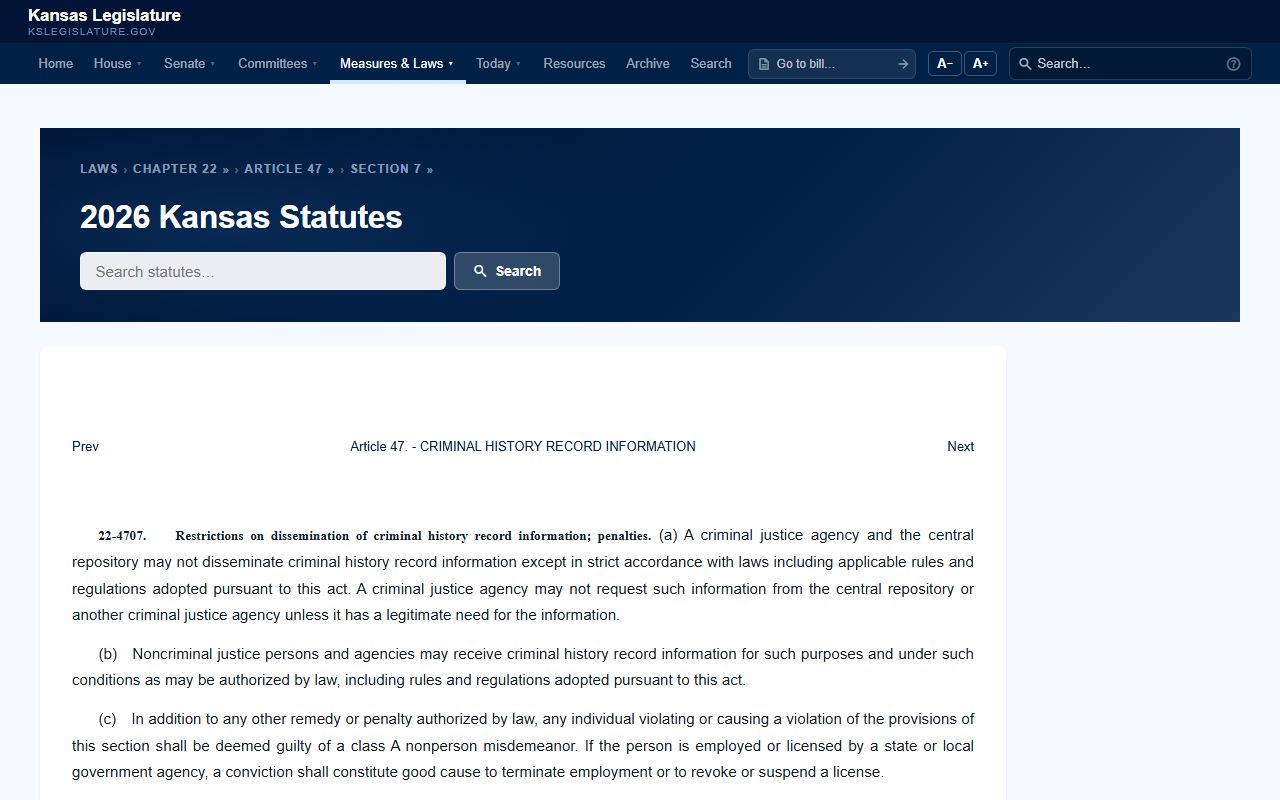
That distinction is critical when a court file is being used to understand a case rather than to run a regulated background check.
Gove Sealed and Expunged Records
Sealed and expunged criminal court records are not ordinary public records. Sealed records are hidden from public access by statute or court order. Expungement limits ordinary disclosure of eligible convictions, arrest records, or diversion agreements after the court grants relief. Kansas CaseSearch and courthouse terminals do not provide sealed cases or sealed records, and a missing search result does not prove no case, warrant, or order exists.
| Sealed | Expunged | |
|---|---|---|
| Public View | Closed or redacted from public court access. | Limited from ordinary disclosure after a court order. |
| Kansas Law | K.S.A. 60-2617 addresses sealing, redaction, and closed proceedings. | K.S.A. 21-6614 covers certain adult convictions, arrest records, and diversion agreements. |
| Access Route | Usually requires court authorization or statutory access. | Depends on the expungement order and statutory exceptions. |
| Common Limits | Warrant-related materials, protected identities, juvenile, mental health, and safety data. | Some government, law-enforcement, or later criminal-proceeding uses may remain. |
The manifest image for Kansas adult expungement law connects Gove County criminal court records to the statewide expungement process.
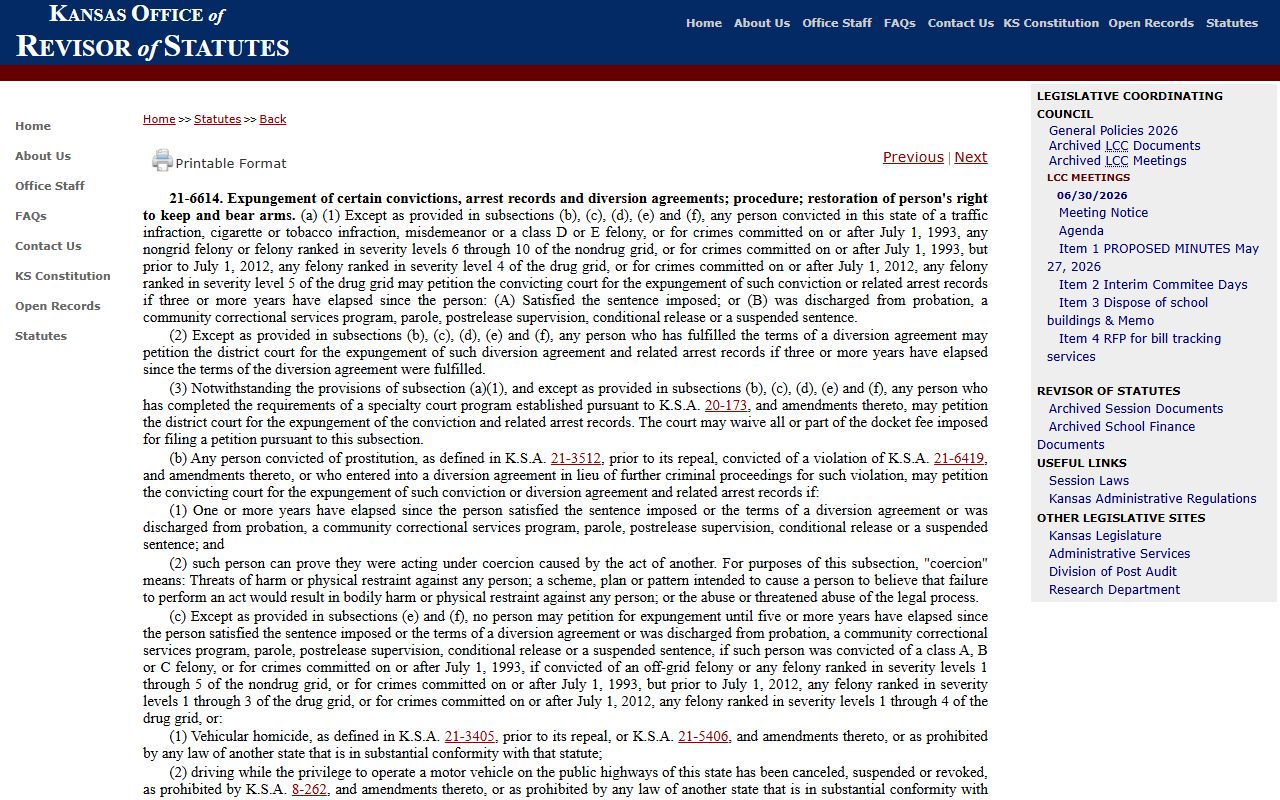
Adult expungement is a court process. It is not the same as deleting every trace of a case from every government system.
Restricted Gove Criminal Records
Juvenile cases are a major restriction. The 23rd Judicial District docket page says JC and JV calendar items are confidential and not live streamed. Kansas juvenile expungement is governed by K.S.A. 38-2312. Juvenile offender, child-in-need-of-care, and related juvenile records have disclosure limits that are much tighter than ordinary adult criminal case dockets.
Other restricted criminal court records can include sealed warrant materials, mental health and care or treatment records, protected victim information, Social Security numbers, financial account numbers, protected addresses, medical or diagnostic details, and records closed by court order. Live-stream limits reinforce the same point: confidential categories are not public events, and recording any live stream is prohibited.
The manifest image for Kansas juvenile expungement law shows why juvenile-related Gove County criminal court records require separate treatment.
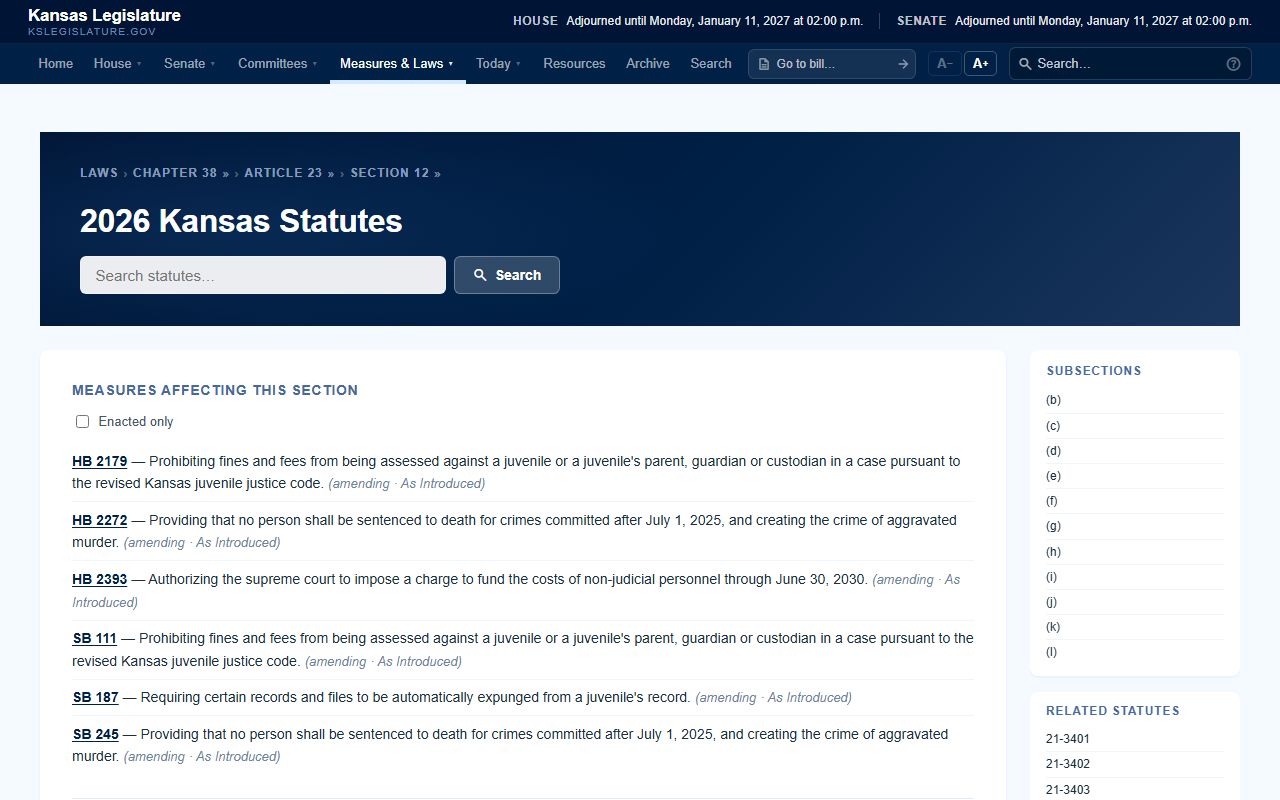
Juvenile confidentiality affects docket display, live-stream access, copy requests, and the public's ability to view or reuse case information.
Gove Criminal Case Copies
Use the Gove County District Court clerk for certified criminal case copies, non-online public documents, older file questions, and public-terminal access. The local court is at 420 Broad Street, PO Box 97, Gove, Kansas 67736. The office phone is 785-938-2310, the email is Gove_County_Clerk@kscourts.gov, and hours are Monday through Friday, 8:00 a.m. to 4:30 p.m. Copy fees were not located in the official Gove research, so fees should be confirmed with the clerk before submitting a large request.
Gove County District Court
420 Broad Street, PO Box 97
Gove, KS 67736
785-938-2310
Gove_County_Clerk@kscourts.gov
Monday-Friday, 8:00 a.m.-4:30 p.m.
For a person in current custody, use the inmate records path instead of the criminal court file. Gove County contracts with surrounding counties for inmate housing, so custody location and court case status may be in different systems.